Most American Babies Are Born With Some Type of Genetic Disorder
What is Usher syndrome?
Usher syndrome is the most common condition that affects both hearing and vision; sometimes information technology also affects residuum. The major symptoms of Usher syndrome are deafness or hearing loss and an eye disease called retinitis pigmentosa (RP) [re-can-EYE-tis pig-men-TOE-sa].
Deafness or hearing loss in Usher syndrome is caused by abnormal evolution of hair cells (sound receptor cells) in the inner ear. Most children with Usher syndrome are built-in with moderate to profound hearing loss, depending on the type. Less usually, hearing loss from Usher syndrome appears during adolescence or later. Usher syndrome can also cause severe balance problems due to aberrant development of the vestibular hair cells, sensory cells that find gravity and head movement.
RP initially causes night-incomprehension and a loss of peripheral (side) vision through the progressive degeneration of cells in the retina. The retina is the calorie-free-sensitive tissue at the back of the eye and is crucial for vision. Every bit RP progresses, the field of vision narrows until only central vision remains, a condition called tunnel vision. Cysts in the macula [MAC-u-la] (the central part of the retina) and cataracts (clouding of the lens) can sometimes cause an early decline in central vision in people with Usher syndrome.
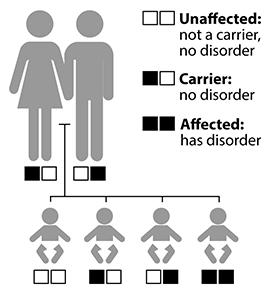
Chances of inheriting a recessive disorder
The hearing, balance, and vision of carriers with one mutant Usher cistron is typically normal. Carriers are often unaware of their status.
Source: NIH/NIDCD
Who is afflicted by Usher syndrome?
Usher syndrome affects approximately 4 to 17 per 100,000 people,1 , 2 and accounts for virtually fifty percent of all hereditary deaf-incomprehension cases.3 The condition is thought to business relationship for 3 to 6 percent of all children who are deaf, and some other 3 to 6 percent of children who are difficult-of-hearing.four
What causes Usher syndrome?
Usher syndrome is inherited, which means that it is passed from parents to a child through genes. Each person inherits two copies of a gene, ane from each parent. Sometimes genes are contradistinct, or mutated. Mutated genes may cause cells to develop or act abnormally.
Usher syndrome is inherited equally an autosomal recessive disorder. "Autosomal" means that men and women are equally likely to take the disorder and every bit likely to laissez passer it on to a kid of either sex. "Recessive" means that the condition occurs only when a child inherits two copies of the aforementioned faulty gene, 1 from each parent. A person with one abnormal Usher gene does not have the disorder simply is a carrier who has a 50 percent chance of passing on the abnormal cistron to each kid. When ii carriers with the same mutated Conductor syndrome gene have a child together, each nascence has a:
- One-in-four risk of having a child who neither has Usher syndrome nor is a carrier.
- Two-in-four chance of having a child who is an unaffected carrier.
- I-in-four chance of having a child who has Usher syndrome.
What are the characteristics of the three types of Usher syndrome?
There are three types of Usher syndrome. In the U.s.a., types 1 and 2 are the most common. Together, they business relationship for upward to 95 per centum of Usher syndrome cases.5
Blazon 1: Children with type 1 Usher syndrome have profound hearing loss or deafness at nascency and take astringent balance problems. Many obtain little or no benefit from hearing aids but may be candidates for a cochlear implant—an electronic device that can provide a sense of sound to people with astringent hearing loss or deafness. (For more than information, read the NIDCD fact sheet Cochlear Implants.) Parents should consult with their child's doctor and other hearing wellness professionals early on to make up one's mind advice options for their child. Intervention should begin promptly, when the brain is most receptive to learning linguistic communication, whether spoken or signed.
Remainder problems associated with type 1 Conductor syndrome delay sitting up without back up. Walking rarely occurs prior to 18 months. Vision bug with type one Conductor syndrome unremarkably begin before age 10, starting with difficulty seeing at night and progressing to severe vision loss over several decades.
Type 2: Children with type 2 Usher syndrome are born with moderate to severe hearing loss merely normal balance. Although the severity of hearing loss varies, nearly children with type 2 Usher syndrome can communicate orally and benefit from hearing aids. RP is usually diagnosed during tardily adolescence in people with type 2 Usher syndrome.
Type 3: Children with type iii Usher syndrome have normal hearing at birth. Most have normal to near-normal residual, only some develop balance problems with age. Decline in hearing and vision varies. Children with type 3 Usher syndrome often develop hearing loss past adolescence, requiring hearing aids past mid-to-late adulthood. Night blindness also commonly begins during adolescence. Bullheaded spots appear past the late teens to early twenties. Legal blindness often occurs by midlife.
| Type one | Type 2 | Type 3 | |
|---|---|---|---|
| Hearing | Profound hearing loss or deafness at birth. | Moderate to severe hearing loss at nativity. | Progressive hearing loss in childhood or early teens. |
| Vision | Decreased nighttime vision by age 10, progressing to severe vision loss past midlife. | Decreased night vision by adolescence, progressing to astringent vision loss by midlife. | Varies in severity and historic period of onset; dark vision problems often begin in teens and progress to severe vision loss by midlife. |
| Balance (vestibular function) | Residue problems from birth. | Normal balance. | Normal to most-normal |
How is Usher syndrome diagnosed?
Diagnosis of Usher syndrome involves pertinent questions regarding the person'due south medical history and testing of hearing, balance, and vision. Early diagnosis is of import, as it improves handling success. An heart care specialist can apply dilating drops to examine the retina for signs of RP. Visual field testing measures peripheral vision. An electroretinogram [eastward-lec-tro-RET-in-o-gram] measures the electrical response of the eye'southward light-sensitive cells in the retina. Optical coherence tomography may be helpful to assess for macular cystic changes. Videonystagmography [vi-de-o-well-nigh-stag-MAH-gra-fee] measures involuntary eye movements that could signify a rest trouble. Audiology testing determines hearing sensitivity at a range of frequencies.
Genetic testing may help in diagnosing Usher syndrome. So far, researchers have establish nine genes that crusade Usher syndrome. Genetic testing is available for all of them:
- Type one Conductor syndrome: MY07A, USH1C, CDH23, PCHD15, USH1G
- Type two Usher syndrome: USH2A, GPR98, DFNB31
- Type 3 Usher syndrome: CLRN1
Genetic testing for Usher syndrome may be available through clinical enquiry studies. Search for "Usher syndrome" or "Conductor genetic testing" at the NIH Clinical Trials website.
How is Conductor syndrome treated?
Presently, in that location is no cure for Usher syndrome. Handling involves managing hearing, vision, and balance problems. Early on diagnosis helps tailor educational programs that consider the severity of hearing and vision loss and a child's age and ability. Treatment and communication services may include hearing aids, assistive listening devices, cochlear implants, auditory (hearing) training, and/or learning American Sign Language. Independent-living grooming may include orientation and mobility grooming for balance problems, Braille educational activity, and low-vision services.
Vitamin A may irksome the progression of RP, co-ordinate to results from a long-term clinical trial supported by the National Center Found and the Foundation Fighting Blindness.half dozen Based on the study, adults with a mutual grade of RP may do good from a daily supplement of 15,000 IU (international units) of the palmitate form of vitamin A. Patients should discuss this handling option with their health care provider earlier proceeding. Because people with blazon 1 Usher syndrome did not take part in the study, high-dose vitamin A is not recommended for these patients.
Full general precautions for vitamin A supplementation:
- Do non substitute vitamin A palmitate with a beta-carotene supplement.
- Do not take vitamin A supplements greater than the recommended dose of 15,000 IU or modify your diet to select foods with high levels of vitamin A.
- Significant women should not take high-dose vitamin A supplements due to the increased risk of birth defects. Women considering pregnancy should stop taking high-dose vitamin A supplements for six months earlier trying to conceive.
What research is being conducted on Usher syndrome?
Researchers are trying to identify boosted genes that crusade Usher syndrome. Efforts volition pb to improved genetic counseling and earlier diagnosis, and may somewhen aggrandize treatment options.
Scientists are besides developing mouse models with characteristics similar to Conductor syndrome. Research using mouse models will assist determine the function of Usher genes and inform potential treatments.
Other areas of study include developing new methods for early identification of children with Conductor syndrome, improving handling strategies for children who apply hearing aids or cochlear implants for hearing loss, and testing innovative intervention strategies to assistance irksome or terminate the progression of RP. Clinical researchers are besides characterizing variability in balance among individuals with diverse types of Usher syndrome.
Visit the NIH Clinical Research Trials and You website to read well-nigh these and other clinical trials that are recruiting volunteers.
Where tin I go more information about Usher syndrome?
The NIDCD maintains a directory of organizations that provide information on the normal and disordered processes of hearing, remainder, sense of taste, smell, voice, speech, and linguistic communication.
NIDCD Information Clearinghouse
i Communication Avenue
Bethesda, Md 20892-3456
Toll-free voice: (800) 241-1044
Toll-complimentary TTY: (800) 241-1055
Email: nidcdinfo@nidcd.nih.gov
National Eye Institute
National Eye Institute Communications Role
31 Center Drive MSC 2510
Bethesda, MD 20892-2510
Phone: (301) 496-5248
Electronic mail: 2020@nei.nih.gov
https://nei.nih.gov
NIH Pub. No. 98-4291
December 2017
4 National Library of Medicine. Usher syndrome. Genetics Home Reference: Your Guide to Understanding Genetic Conditions.
5 Saihan, Z., Webster, A.R., Luxon, Fifty., Bitner-Glindzicz, Chiliad. (2009). Update on Usher syndrome. Current Opinion in Neurology, 22(1), nineteen–27.
Source: https://www.nidcd.nih.gov/health/usher-syndrome
0 Response to "Most American Babies Are Born With Some Type of Genetic Disorder"
Post a Comment